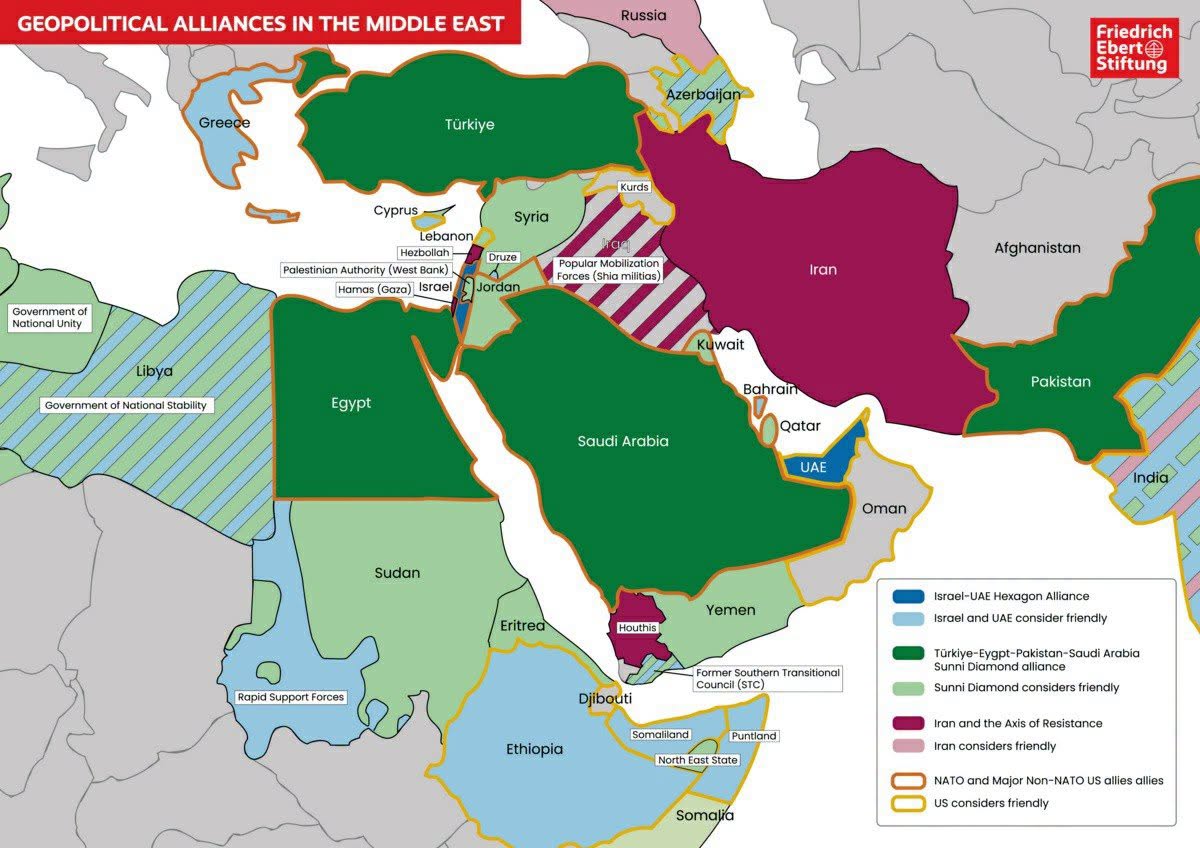
The geopolitical map of the Middle East in 2026 is defined by a multi-polar realignment, featuring an integrated US backed technological and defence network (including Abraham Accords nations), a rising middle-power quadrilateral, and the fractured Iranian “Axis of Resistance”.
The Israel-UAE-Western Alignment (The Abraham/Hexagon Bloc), the core partnership: is Israel and the United Arab Emirates who form a high-tech, intelligence, and financial anchor.
In an expanded framework it includes Bahrain and Morocco from the Abraham Accords, alongside strategic Mediterranean and global partners like India, Greece, and Cyprus, focusing on cybersecurity, defense systems, and AI cooperation
The emerging Middle-Power Quadrilateral of the new Riyadh Quad, a diplomatic axis emerged in early 2026 involving Saudi Arabia, Egypt, Türkiye, and Pakistan.
This grouping acts as a flexible middle-power counterweight balancing traditional Western ties with regional autonomy, spanning vast energy reserves, large military forces, and nuclear capability
Third is the Axis of Resistance led by Iran, connecting proxy and militia networks across Lebanon (Hezbollah), Iraq, and Yemen (the Houthis), which faced intense military and strategic friction with US-Israeli coalitions.